
Should You Take Thai Yoga Massage Level 1 or the Thai Stretch Therapy Specialist Course?
If you’ve been looking into training in our Thai bodywork, you’ve probably noticed something quickly: there are a few different paths you can take.

Two of the most common starting points for our students are Thai Yoga Massage Level 1 or our Thai Stretch Therapy Specialist (TST/S) course.
At first glance they may seem similar—both involve assisted stretching and hands-on bodywork—but in reality they are designed for very different goals.
The best course for you really depends on what you want to do with the skills afterward.
Let’s break down the key differences so you can decide which one fits you best.

Thai Yoga Massage Level 1: The Traditional Foundation
Thai Yoga Massage is a complete bodywork system that has been practiced for centuries. It blends compression techniques, stretching, acupressure points, joint mobilization, and rhythmic movement into one flowing treatment.
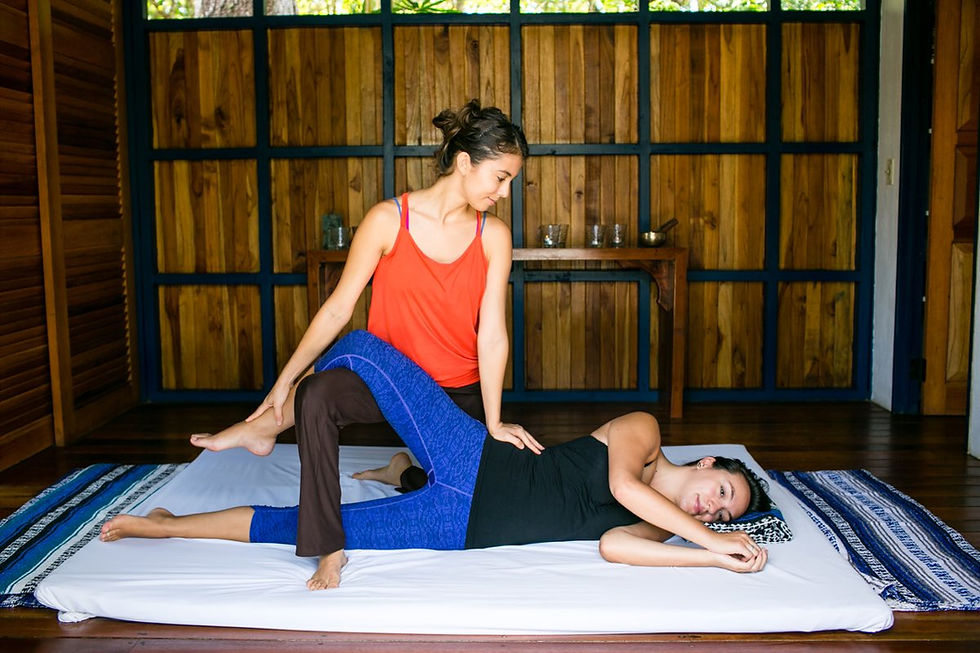
Unlike most Western massage styles, sessions are performed (traditionally) on a floor mat, and the client stays fully clothed.
In our Level 1 training, you begin learning the foundation of the entire system.
Students are introduced to:
Traditional pressure techniques
Assisted stretches
Energy line work
Foundational lower body, neck, shoulder, and back techniques
To offer a full-body treatment flow
The emphasis is on learning a complete therapeutic experience, not just isolated techniques.
A session can feel like a combination of massage, yoga, mobility work, and meditation all in one.
For students who want to truly study Thai bodywork as an art and a practice, this course is the natural starting point.
It’s deeper, broader, and sets the foundation for further Thai Massage training.
Our L1 course is 25 hours.
Thai Stretch Therapy Specialist (TST/S): A Modern Assisted Stretch System
The Thai Stretch Therapy Specialist (TST/S) course takes a very different approach.
Instead of teaching the entire Thai Massage system, it focuses on one powerful component: assisted stretching.
Over the past few years, assisted stretching has exploded in popularity. Clinics, gyms, and studios everywhere are offering stretching services to help clients move better, recover faster, and reduce pain.
TSTS was designed specifically for that growing demand.
Rather than teaching floor-based Thai massage, this course focuses on stretch therapy performed on a bodywork table. That makes it easy to integrate into environments like:
Personal training studios
Chiropractic clinics
Massage therapy clinics
Athletic performance centers
Yoga studios
The training focuses almost entirely on mobility and stretching techniques.
You won’t spend time learning pressure points, traditional energy line work, or the deeper massage elements found in Thai Yoga Massage.
Instead, the focus is on helping clients:
Improve mobility
Increase flexibility
Reduce muscular tightness
Move more efficiently
It’s streamlined, practical, and designed to be applied immediately in modern fitness and wellness environments.
Our TST/S Course is 15 hours delivered over 2 full days.
Table vs Floor: A Big Practical Difference
One of the most noticeable differences between the two courses is where the work happens.
Thai Yoga Massage is traditionally done on a floor mat. The practitioner uses their hands, forearms, knees, and even body weight to move and stretch the client through a wide variety of positions.
It’s dynamic and flowing, but it does require space and a different setup than most clinics or gyms.
TSTS, on the other hand, is performed on a treatment table.
For many professionals—especially massage therapists, trainers, or clinic-based practitioners—this makes it much easier to integrate into their existing practice.
You don’t need extra floor space, and sessions can fit easily into a standard treatment room.
Saying this, I'd like to note - you can take TST to the floor if you prefer.
Who Thai Yoga Massage Is Best For
Thai Yoga Massage Level 1 is ideal for people who want to learn the full traditional system.
It’s a great choice if you:
Want to study authentic Thai bodywork
Are interested in traditional healing arts
Plan to continue into advanced Thai Massage training
Want to offer full Thai massage sessions or work in a spa setting.
This course provides a broader and deeper foundation in the art of Thai bodywork.
Many students fall in love with the flowing style, the philosophy behind it, and the powerful effects it has on the body.
Who the TSTS Course Is Best For
The Thai Stretch Therapy Specialist course was created with modern movement professionals in mind.
It’s especially useful for:
Personal trainers
Strength and conditioning coaches
Athletic therapists
Yoga instructors
Massage therapists
Rehab professionals
Working in a more "gym or fitness studio" setting
If your main goal is helping clients move better, the TST/S system gives you the tools to do exactly that.
It’s shorter, more focused, and designed to integrate easily into fitness and clinical settings.
Instead of learning a full massage modality, you learn a powerful mobility service you can add to what you already do.
Depth vs Specialization
One way to think about the difference is this:
Thai Yoga Massage Level 1 teaches a full bodywork system.TST/S teaches a specialized mobility service.
Neither is better—they simply serve different purposes.
Some students want to dive deep into Thai massage and explore the full tradition behind it, or move into our Level 2 adanced course.
Others may simply want effective assisted stretching techniques they can use with their clients right away.
Both paths are valuable.
The key is choosing the one that aligns with your goals.
Which Course Should You Choose?
If you’re drawn to the traditional and complete art of Thai bodywork, enjoy the idea of working on the floor, and want to study a complete therapeutic system, Thai Yoga Massage Level 1 is likely the better fit.
If you’re primarily interested in assisted stretching and mobility work, want something practical for modern fitness or clinic settings, and prefer working on a table, the Thai Stretch Therapy Specialist (TST/S) course may be exactly what you’re looking for.
Some practitioners take both.
They learn the traditional Thai system first, then later add table-based stretch therapy to expand their services. Others start with TST/S to quickly add assisted stretching to their practice.
There’s no wrong path.
It simply depends on where you want to take your work.
The Bottom Line
Both courses are built around the powerful principles of Thai bodywork: movement, mobility, and working with the body instead of against it.
The difference is how deep you want to go, and how you want to apply it.
Thai Yoga Massage Level 1 offers the traditional foundation.
Thai Stretch Therapy Specialist offers a focused, modern mobility system designed for today’s wellness and fitness professionals.
Either way, you’ll walk away with skills that help people feel better, move better, and reconnect with their bodies.
And that’s the real goal of great bodywork.
Check out both courses on our website and sign up for one today.

Comments